


HKUST Scientists Develop DNA-Guided CRISPR Tool for Virus Detection
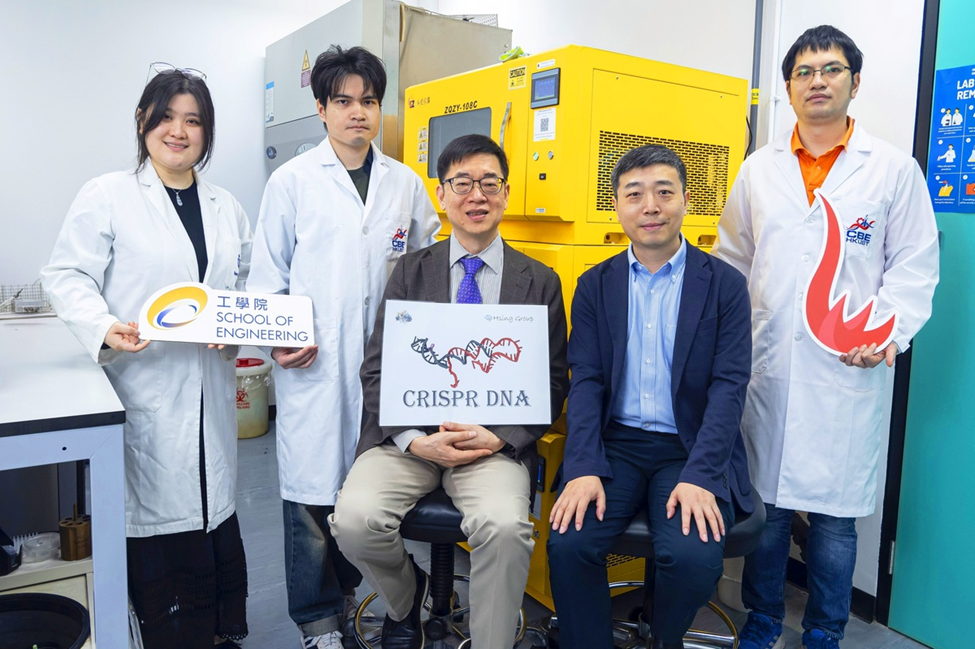
Figure: The research team led by Prof. Hsing I-Ming (third left), Prof. Zhai Yuanliang (second right), Mr. Wu Xiaolong (second left), Dr. Lam Wai-Hei (first right), and Dr. Cao Yumeng (first left). (Photo Source: The Hong Kong University of Science and Technology (HKUST))
Researchers from The Hong Kong University of Science and Technology (HKUST) have developed the world's first DNA-guided CRISPR-Cas system capable of targeting and cutting RNA. The study introduces a new diagnostic platform called SLEUTH (Specific Locus Evaluation Utilizing Targeted Hydrolysis), which uses synthetic DNA guides instead of the traditional RNA guides used in CRISPR systems.
The team, led by Professors Hsing I-Ming and Zhai Yuanliang, redesigned the CRISPR-Cas12a system to recognize RNA using engineered DNA molecules called crDNA. Unlike conventional CRISPR tools, which rely on RNA guides to locate DNA targets, the new system uses DNA guides to direct the protein toward RNA molecules. According to the team, the DNA-guided approach is more stable, cost-effective, and precise than existing RNA-based systems, while also reducing off-target effects.
Tests on 31 clinical SARS-CoV-2 samples showed the platform could accurately detect viral RNA and distinguish targets with high sensitivity. The researchers said the technology could improve rapid virus detection and support the development of future RNA-targeted treatments. The technology could support point-of-care testing in clinics, airports, and resource-limited settings because it does not require cold-chain storage.
For more information, read the article from The Hong Kong University of Science and Technology.
See https://www.isaaa.org/kc/cropbiotechupdate/article/default.asp?ID=21821
Views: 7