


Strengthening seed systems in Liberia: EU-project improving access to high-quality coffee seedlings via regional seedling nursery hubs
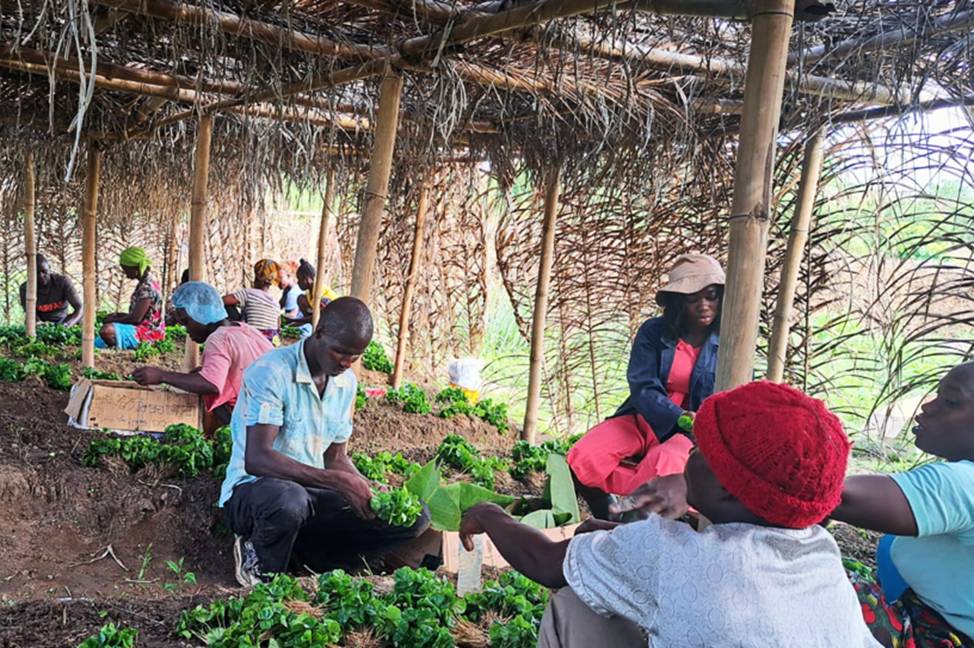
Figure: Coffee Germplasm Seedling Garden at CARI developed by the EU-Seeds4Liberia Project (Credit: George A. Harris, fricaRice -Liberia Station)
In Liberia, the EU-funded Seeds4Liberia Project is expanding access to high-quality coffee seedlings from research facilities to farming communities through a centralized coffee nursery hub model.
National context
In the pre-war Liberia era, coffee was a high economic crop, especially Liberica coffee, which is unique to the country. The coffee sector in Liberia produced 5 percent of the world’s coffee. However, the 14-year civil war destroyed coffee production systems. Post-war, Liberian farmers relied on informal seed distribution networks to keep their farms alive, facing a high risk of loss from climate adversities including pests and diseases affecting low-yielding varieties and non-availability of good quality planting materials.
As part of the revitalization efforts of Liberia’s coffee sector, the EU-backed project has established four centralized seedling nursery hubs to improve access to high-quality coffee seedlings for producers in Liberia’s central, eastern, and northwestern regions. The model was conceptualized and employed after the distribution of 267,000 coffee seedlings to farmers in 2025.
The International Institute of Tropical Agriculture (IITA), in collaboration with the Ministry of Agriculture (MoA), the Central Agricultural Research Institute (CARI), the Liberia Agricultural Commodity Regulatory Authority (LACRA), and the Seeds Development and Certification Agency (SDCA), worked together to identify ideal locations across the selected regions in Liberia to establish the centralized seedling nursery hubs.
IITA, through the EU-funded Seeds4Liberia Project, is expected to transfer 400,000 coffee seedlings across the four centralized nursery hubs in Bong, Lofa Nimba, and Montserrado in 2026. These nursery hubs will act as centralized seedling distribution hubs to benefit coffee-producing farmers from Bomi, Bong, Montserrado, Lofa, and Nimba counties as well as other counties where coffee can be successfully grown. Eventually, they will become business hubs wherein high-quality coffee seedlings will be produced every year and distributed to farmers.
In addition to improving access to high-quality coffee seedlings, the nursery hubs will also serve as centers for capacity strengthening of extension officers as well as farmers through knowledge transfer and improve beneficiary skills on best coffee nursery production practices.
IITA is one of the implementing institutions of the EU-funded Seeds4Liberia Project. Under the project, IITA leads cassava, coffee, and soybean value chains, WorldFish leads the fish value chain, while AfricaRice—the project’s lead implementing organization—oversees the rice component. The project is implemented in collaboration with the MoA,), the National Fisheries Authority (NaFAA), LACRA, and SDCA.
Views: 14