


Molecular and metabolic regulation of anthocyanin accumulation under phosphorus stress in purple-fleshed sweet potato
Lei Zhang, Afsheen Zehra, Rong Jin, Jinhua Zhou, Lili Lu, Wei Jiang, Yan Yang, Zulfiqar Ali Sahito, Wanlin Yang, Zhonghou Tang
Plant Physiol Biochem.; 2026 Apr: 233:111061. doi: 10.1016/j.plaphy.2026.111061.
Abstract
Purple-fleshed sweet potato (PFSP) (Ipomoea batatas) is a rich source of anthocyanins, which serve as potent antioxidants and contribute to stress tolerance. However, the molecular mechanisms regulating anthocyanin biosynthesis in PFSP under phosphorus stress remain poorly understood. In this study, integrated transcriptomic and metabolomic analyses were conducted using the sweet potato cultivar (Xuzishu No. 8) grown under three phosphorus treatments: XP0 (0 g), XP1 (1.85 g), and XP2 (3.70 g). Although phosphorous did not significantly affect total anthocyanin content, however, marked changes were observed in the activities of key biosynthetic enzymes (CHl, DFR, OPC, PAL and UFGT). RNA-seq analysis identified 8,906 differentially expressed genes (DEGs) with 11,215 novel genes across the treatments. KEGG pathway enrichment analysis revealed that most DEGs were associated phenylpropanoid biosynthesis. Metabolomic profiling detected 110 differentially expressed metabolites (DEMs) among which six were common to all treatments and sixteen metabolites were shared between the treatment groups. Functional annotation of DEMs indicated an overall suppression of anthocyanin biosynthesis pathway, across the treatments, whereas, flavone and flavonol biosynthesis remained consistently active. Notably, Quercetin-3-O-glucoside appeared to play a key role in the restoring anthocyanin biosynthesis. Integrated transcriptome-metabolome analysis showed a strong coordinated regulation between DEGs and DEMs, particularly within anthocyanin and flavonoid biosynthetic pathways. Furthermore, Canonical correspondence analysis (CCA) and principal component analysis (PCA) biplot further revealed that anthocyanin accumulation is controlled by the combined action of multiple genes, with Tai6.6720 identified as a key regulatory gene closely linked with active metabolites (Pelargonidin-3-O- glucoside and cyanidin-3-O- glucoside). Overall, these findings highlight the significant impact of phosphorous stress on transcriptional and metabolic reprogramming of anthocyanin biosynthesis as an adaptive response. This study provides new insights on the regulatory networks that control anthocyanin accumulation in sweet potato and offers a valuable foundation for nutrient management strategies and molecular breeding approaches to improve crop stress tolerance.
See https://pubmed.ncbi.nlm.nih.gov/41941854/
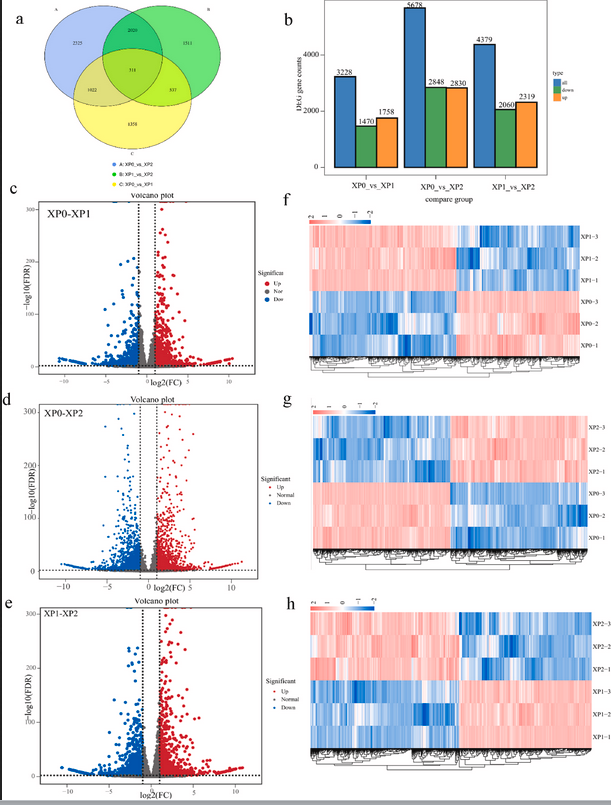
Fig. 2. Differential expression analysis. a. Venn diagram of DEGs between samples. Shows the number of unique DEGs between each comparing pair and overlapping of DEGs between different comparing pairs. b. Statistics on DEGs. c-e. Volcano plot on differential expression in different groups (each dot represent a gene, X-axis: log2Fold change of expression, Y-axis: log10 (FDR)/-log10 (p-value). Dots farther to x = 0 represents gene of which the difference is more reliable. Green dots are down-regulated genes, while red dots are up-regulated ones and black dots are genes without significant difference. f-h. Hierarchical clustering of DEGs in different samples (Each column represents one sample and rows represent genes. The expression level of genes (FPKM) was normalized by log10, i.e. log10(FPKM+0.000001) and presented as different colors based on scale bar.
Views: 4