


An auxin-induced transcriptional cascade CmBES1–CmSAUR66 orchestrates the ray floret development in Chrysanthemum morifolium
Diwen Jia, Yuhang Zhang, Jiangshuo Su, Jiaqi Wang, Weiming Zhang, Song Li, Libang Ma, Jiafu Jiang, Sumei Chen, Lian Ding, and Fadi Chen
PNAS April 27, 2026; 123 (18) e2527961123; https://doi.org/10.1073/pnas.2527961123
Significance
The fusion of petals into a corolla tube was a key innovation in flower evolution. Still, its genetic control in lineages with petals initiating from a shared ring primordium remains mysterious. We identify a regulatory module in chrysanthemum where the auxin-induced transcription factor CmBES1 directly represses the early auxin-responsive gene CmSAUR66 to orchestrate corolla tube formation. This repression promotes dorsal petal elongation by modulating the dorsoventral factor CmCYC2c. Our work thus unveils a not previously reported hormone-transcription factor module that integrates auxin signaling with dorsoventral patterning to control a primary floral morphological trait, providing fundamental insights into the evolution of floral form.
Abstract
Sympetaly (fused petals) is a key morphological innovation that has arisen multiple times during evolution. It occurs via one of two developmental pathways: late sympetaly (from initially separate petal primordia that later fuse) or early sympetaly (directly from a shared ring-like primordium). Nevertheless, the genetic basis of corolla tube formation in early-sympetalous lineages remains largely unknown. In Chrysanthemum morifolium, an early-sympetalous species, ray floret corolla tube formation depends specifically on dorsal petal elongation. Through integrated genome-wide association studies and RNA-seq analyses, we identified CmSAUR66 as a negative regulator of corolla tube fusion. Functional studies showed that CmSAUR66 knockdown enhances corolla tube fusion by promoting dorsal petal elongation. Mechanistically, CmSAUR66 acts by modulating the spatiotemporal expression of the dorsoventral asymmetry gene CmCYC2c; knocking down CmCYC2c in the amiR-CmSAUR66 background rescues the fusion phenotype. We found that sustained auxin treatment promotes corolla tube fusion while suppressing CmSAUR66 expression, and knocking down this gene alters auxin sensitivity. Importantly, we found that the auxin-induced transcription factor CmBES1 directly represses CmSAUR66 expression. Consistent with this, transient overexpression of CmSAUR66 in OX-CmBES1 plants significantly rescued the fusion phenotype. Our study thus unveils the CmBES1–CmSAUR66 regulatory module as a central component of auxin-mediated sympetalous development, providing insights into the hormonal control of floral morphological evolution.
See https://www.pnas.org/doi/10.1073/pnas.2527961123
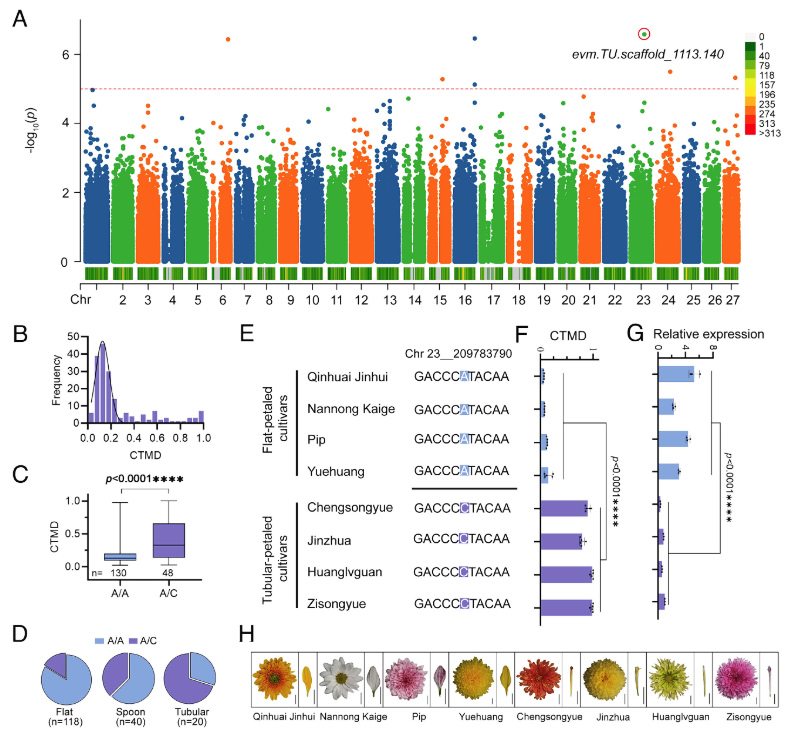
Figure 1:
Genome-wide association analysis identifies evm.TU.scaffold_1113.140 as a candidate regulator of ray floret morphology in chrysanthemum. (A) Manhattan plot for the ray floret type trait. Each point represents an SNP. Chromosomal positions are shown on the x-axis, and the −log10 (P) values are on the y-axis. The red horizontal dashed line indicates the genome-wide significance threshold. Chr, chromosome. (B) Frequency distribution of CTMD across 200 accessions in single environments (Y2020). (C) Association of two natural variations and ray florets CTMD. Whiskers represent the range of data distribution. (D) Allele frequencies of the SNP among the flat, spoon, and tubular groups. (E) Sanger sequencing chromatograms of the candidate SNP Chr 23__209783790. Blue and purple markers represent the SNP location. (F) CTMD values of representative accessions shown in H carrying different alleles. Data are shown as means ± SD. CTMD was measured from ray florets derived from five independent plants (n = 5 inflorescences). (G) Relative expression of evm.TU.scaffold_1113.140 in ray florets of accessions (H) at 4 mm inflorescence diameter stage. Data are shown as means ± SD (n = 3 biological replicates). (H) The inflorescences and ray florets of eight accessions, i.e., ‘Qinhuai Jinhui’, ‘Nannong Kaige’, ‘Pip’, ‘Yuehuang’, ‘Chengsongyue’, ‘Jinzhua’, ‘huanglvguan’, and ‘Zisongyue’.
Views: 3