


Resistance gene against Xanthomonas oryzae pv. oryzae (Xoo) in rice: molecular mechanisms and breeding strategies for bacterial leaf blight
Hongrui Jiang, Qina Huang, Changdeng Yang, Yan Liang
Front Plant Sci.; 2026 Feb 13: 17:1744367. doi: 10.3389/fpls.2026.1744367.
Abstract
Bacterial leaf blight (BLB), caused by Xanthomonas oryzae pv. oryzae (Xoo), is one of the most devastating diseases threatening global rice production. In recent decades, a range of disease resistance genes have been identified in rice. These genes are involved in complex molecular mechanisms, such as the activation of immune receptors and defense signaling pathways, which trigger the plant's immune response to combat pathogen invasion. Some of these genes have been successfully applied in molecular breeding to develop new disease-resistant varieties. However, traditional breeding methods, which rely heavily on the experience and intuition of breeders, often face limitations in speed and efficiency. With the emergence of artificial intelligence (AI) technologies, there is growing interest in using them to accelerate the breeding of disease-resistant cultivars. This review summarizes the current understanding of the molecular mechanisms underlying BLB resistance, focusing on key resistance genes and their roles in defense responses. It also explores breeding strategies aimed at enhancing resistance and evaluates the opportunities and challenges of AI tools into rice disease resistance breeding.
See https://pubmed.ncbi.nlm.nih.gov/41768056/
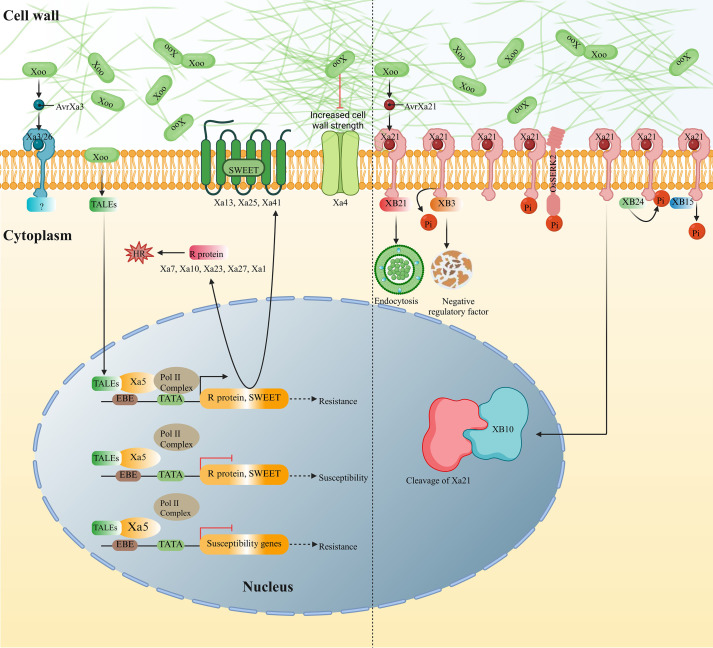
Figure 1. Molecular mechanism of the cloned gene conferring resistance to BLB. (left) This schematic diagram illustrates the key molecular processes involved in the resistance conferred by the cloned resistance gene. Upon pathogen recognition, Xa21 and Xa3/Xa26 recognize AvrXa21 and AvrXa3 to activate downstream signaling pathways, respectively. The TALEs proteins are secreted by Xoo entering the plant cell and specifically bind to the promoter regions of susceptible rice genes and activate their expression (SWEET), thereby facilitating infection. The xa5 gene confers resistance by recognizing and counteracting the activity of the TALEs proteins, blocking their ability to induce susceptible gene expression. The R protein is activated by TALE proteins, the activation of R proteins initiates a hypersensitive response (HR), characterized by rapid cell death. This local cell death limits the spread of the pathogen and acts as an effective defense mechanism. The Xa4 protein promotes cellulose synthesis to resist invasion by the BLB. The immune signaling pathways mediated by Xa21, triggered by Xoo (right). Several XA21 binding proteins, including XB3, XB10, XB15, XB21, XB24, OsSERK2 are involved in regulating XA21-mediated resistance. XB3 is essential for the accumulation of XA21. Upon activation, XA21 undergoes phosphorylation by XB3, which triggers the release of negative regulatory factors, promoting disease resistance. XB10 interacts with the cleaved form of XA21, which translocates its intracellular kinase domain to the nucleus and activates the immune response. XB15 dephosphorylates the auto-phosphorylated XA21, thereby dampening XA21-mediated resistance. XB21, an auxilin-like protein, is predicted to function in clathrin-mediated endocytosis, modulating XA21-mediated immunity. XB24 interacts with XA21 and promotes its autophosphorylation, thereby maintaining XA21 in an inactive state. OsSERK2 is a regulator involved in multiple receptor kinase-mediated immune signaling pathways, capable of forming a complex with XA21 and undergoing reciprocal phosphorylation.
Views: 6