


Soil organic nitrogen rather than fertilizer drives dinitrogen losses in flooded rice systems
Yuanyuan Lei, Zhijun Wei, Kaiye Ye, Kees Jan van Groenigen, Yu Liu, Hongna Cui, Klaus Butterbach-Bahl, Pete Smith, Deli Chen, Shu Kee Lam, William R. Horwath, Wulf Amelung, Chaopu Ti, Wei Zhou, Jingrui Yang, Hongbo He, Xudong Zhang, Sheng Zhou, Xiaoyuan Yan, and Longlong Xia
PNAS; April 22 2026; 123 (17) e2603983123; https://doi.org/10.1073/pnas.2603983123
Significance
Flooded rice fields lose large amounts of nitrogen as dinitrogen (N2), yet the sources of this loss remain unclear. Using a cutting-edge in situ isotopic technique, we show that most N2 emissions arise not from fertilizer, as widely assumed, but from soil organic nitrogen mineralized by fertilization-stimulated microbial processes, termed as a microbial nitrogen pump. This hidden pathway highlights a previously overlooked source of soil-derived nitrogen loss, causing conventional methods to overestimate fertilizer-derived losses. Our findings revise nitrogen budgets for rice systems and highlight the need to manage soil–plant–microbe interaction to sustain rice yields while reducing N2 losses. Hybrid rice cultivars markedly lower yield-scaled gaseous nitrogen losses by enhancing plant and microbial nitrogen use efficiency while maintaining high productivity.
Abstract
Rice production underpins food security but relies heavily on nitrogen (N) fertilization, much of which is lost as gaseous emissions. Dinitrogen (N2) represents the largest N loss, yet its sources remain poorly constrained because biological dinitrogen (N2) fluxes are difficult to quantify against the atmospheric background. Here, we apply an in situ 15N tracing–membrane inlet mass spectrometry (15N–MIMS) technique to simultaneously measure N2, ammonia (NH3), and nitrous oxide (N2O) emissions and partition their soil- versus fertilizer-derived origins across the growing season in conventional japonica rice and hybrid rice. We find that soil organic N (SON) accounts for most N2 emissions (72 to 75%), overturning the prevailing assumption that fertilizer dominates this loss pathway, which is independently confirmed by a 14-y fertilization experiment. In contrast, NH3 originates mainly from fertilizer (71 to 77%) and N2O derives from both sources in near-equal proportions. We identify a previously unrecognized “microbial N pump”, in which rapid microbial assimilation of fertilizer-derived ammonium (NH4+) induces stoichiometric imbalance and stimulates SON mineralization, mobilizing soil-derived NH4+ that ultimately fuels N2 emissions, with depleted SON partially replenished through microbial N turnover. Neglecting SON contributions causes systematic overestimation of fertilizer-derived N2 and NH3 losses by ~35%. Hybrid rice increases yield by 59% and reduces yield-scaled gaseous N losses by 43% through enhanced fertilizer uptake and microbial N use efficiency. Together, these findings reveal an underappreciated pathway of fertilization-driven soil N losses, revise N budgets for flooded rice systems, and demonstrate that cultivar-informed management can simultaneously enhance rice productivity and environmental sustainability.
See https://www.pnas.org/doi/10.1073/pnas.2603983123
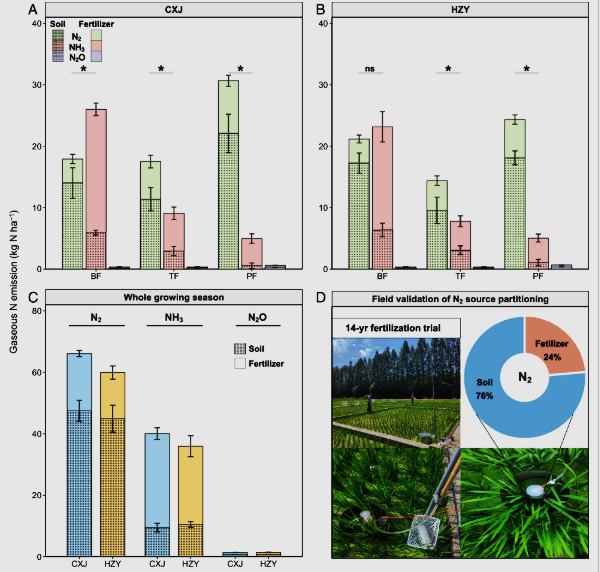
Figure 2: N2, NH3, and N2O emissions and their respective sources during different fertilization periods from CXJ (A) and HZY (B) and across the whole rice-growing season (C), and field validation of N2 source partitioning on a 14-y fertilization experiment (D). Dark shading denotes soil-derived emissions; light shading denotes fertilizer-derived emissions. BF, TF, and PF denote the basal fertilization, tillering fertilization, and panicle-initiation fertilization periods, respectively. Asterisks (*) indicate significant differences between N2 and NH3 emissions at α = 0.05. See Fig. 1 for treatment codes.
Views: 34