


Jacalin-Related Lectin OsJacLK1 Positively Regulates Resistance to Magnaporthe oryzae in Rice
Bingwei Chen, Ruixue Li, Meiling Lai, Haoming Li, Zhongyuan Lin, Sarah Violet Michael, Wenbo Zhu, Jianbo Huang, Songbiao Chen, Yijuan Han
Plants (Basel); 2026 Apr 30; 15(9):1376. doi: 10.3390/plants15091376.
Abstract
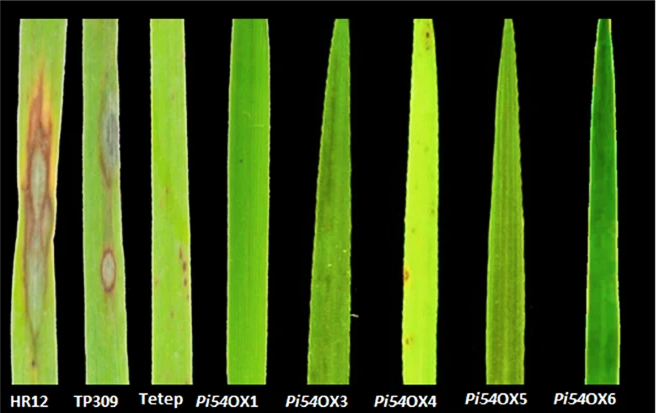
Jacalin-related lectins play crucial roles in plant adaptation to abiotic and biotic stresses. The rice genome encodes four putative jacalin-related lectin kinase genes (OsJacLKs), but their functions toward environmental stresses remain largely uncharacterized. This study demonstrates that a putative jacalin-related lectin kinase, OsJacLK1, conferred resistance to the rice blast fungus Magnaporthe oryzae rather than salt stress. OsJacLK1 protein exhibited agglutination activities and affinity toward chitin, fungal cell wall, and mannose. OsJacLK1 was transcriptionally activated by stress-related phytohormones salicylic acid (SA), methyl jasmonate (MeJA), abscisic acid (ABA), and indoleacetic acid (IAA), as well as salinity, chitin, and M. oryzae inoculation, suggesting its involvement in broad stress-responsive signaling pathways. Overexpression of OsJacLK1 in rice led to reduced susceptibility to rice blast disease, whereas loss-of-function osjaclk1 lines showed no significant phenotypic difference from wild-type plants upon infection. Enhanced resistance in OsJacLK1-overexpressing lines was associated with a stronger reactive oxygen species (ROS) burst and elevated hydrogen peroxide accumulation, accompanied by the up-regulation of defense-related genes (OsRac1, OsSGT1, OsMAPK6, OsPAL1, OsNAC4, OsPBZ1, OsAOS2, and OsJAZ8). Collectively, our findings establish that OsJacLK1 acts as a positive regulator of rice immunity against M. oryzae, modulating the cellular redox state, highlighting its potential as a candidate for genetic improvement of disease resistance in rice.
See https://pubmed.ncbi.nlm.nih.gov/42122868/
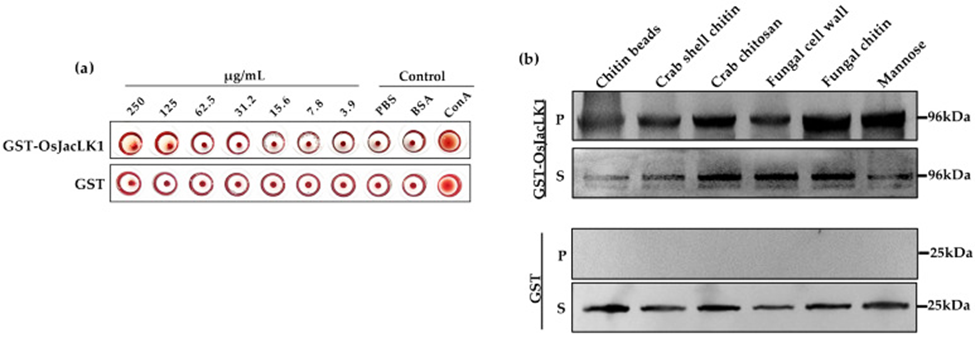
Figure 2
Lectin activity assay and expression pattern of OsJacLK1. (a) Agglutinating activity assay of recombinant GST-OsJacLK1. GST, protein buffer PBS, and Bovine Serum Albumin (BSA, 1 mg/mL) were used as a negative control. Concanavalin A lectin (ConA, 11.0 μg/mL) was applied as a positive control; (b) Carbohydrate-binding assay of recombinant GST-OsJacLK1. At the top, P represents GST-OsMBL1 co-precipitated with the insoluble polysaccharide chitin magnetic beads, crab shell chitin, chitosan, fungal cell wall from M. oryzae (fungal cell wall), chitin from M. oryzae (fungal chitin), and mannose; S represents supernatant fractions. At the bottom, for P and S, the mock GST protein was used as a control and only stayed in the supernatants. GST-tagged proteins were detected with an immune blot by using an anti-GST antibody.
Views: 5